

A Year of Trying Something New: What I Learned Exploring Aurora Through Holly Tries
“I’ve never eaten grasshoppers before…”
I looked down to see seven dead grasshoppers placed next to an orange salt, which I had just learned is sal de gusano (ground agave worms), and four oranges. A combination I didn’t know existed 5 minutes prior.
I was at Molino Chido, an authentic Mexican restaurant located in Stanley Marketplace, and the waitress had just served us this along with our mezcal. I desperately felt like I needed at least two of those shots before even considering eating the grasshoppers.
But just an hour earlier, my manager and I were upstairs in his office brainstorming unique things to try in Aurora and how to show visitors they could explore different cultures without ever leaving the city. Or, in my case that day, without even leaving the building.
If I was going to encourage people to try new things on social media, I realized I needed to start with myself.
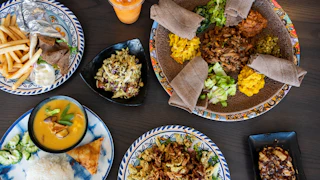
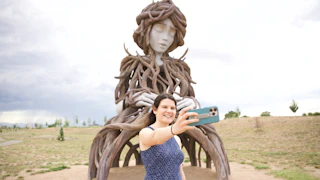
This was the first episode of Visit Aurora's social media series, “Holly Tries Aurora,” where I try something new in Aurora, Colorado each week. Eating grasshoppers was a bold way to start my journey, but this series took me far beyond the Stanley Marketplace. From exploring Mexican food traditions and Ethiopian coffee ceremonies to flinging myself down giant slides and discovering the national dishes of Uruguay, El Salvador, and Myanmar, I found myself experiencing cultures and traditions from places I may never get the opportunity to visit, but places all found within the 165-square-mile limit of Aurora, Colorado.

Lesson of the Week: You Might Get It Wrong at First
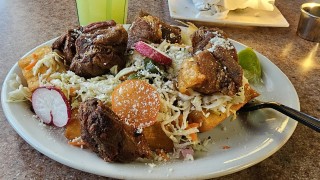
Walking through the doors of Pupusas la Salvadorena, I was immediately greeted with an enthusiastic “¡Hola!” The outside of this building was quite unassuming, but bright blue walls greeted us on the inside. Two TVs were situated on opposite sides of the restaurant playing soccer. It had a neighborhood charm to it, and you could tell the majority of the people here were regulars as they chatted in Spanish to the waitresses.
I ordered a melon juice that tasted as though someone had squeezed a fresh melon just moments before (I think they may have), to go along with our pupusas. A pupusa is a thick handmade corn tortilla stuffed with beans, cheese, or meat. I ordered 4 different varieties, and it probably took me four tries to figure out how to eat them properly. At first I cut my pupusa open with a fork. But something about it felt off. And why did they serve our pupusa with hot salsa and a cabbage slaw?
After watching the regulars around us and doing a quick Google search, I learned that you don't use a fork. Instead, you use your hands and top each bite with curtido, a tangy cabbage slaw, and salsa roja. Once I figured that out, everything clicked, and I had a new favorite.
Every time I visit a new place for Holly Tries, I walk away having learned something, and I include that lesson in the video. The pupusas taught me that trying something new isn't about knowing exactly what you're doing. It's about being willing to try, even if it takes a few attempts to get it right.

Lesson of the Week: Food is just the Beginning of an Experience
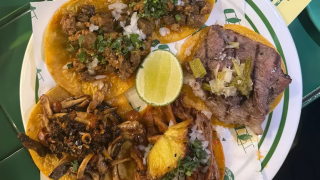
The sizzle of a grill immediately greeted me the moment I walked into Orejano, a Uruguayan restaurant on Havana Street. I came here to film the owner, Marcelo, cooking his specialties today. As I filmed Marcelo cooking, I noticed how often he smiled. He joked with me as he explained how his family grew up cooking together every week. That day, he was preparing chivito, Uruguay's national dish, for a customer. His version has an American twist: habanero mayonnaise.
“So I try to see what I like from here and what I like from Uruguay, and try to make a fusion,” Marcelo explains in a podcast episode focused on his story.
“We [Uruguay] have a strong influence from Spain or Italy in our food. The most traditional dishes for us was the Chivito, that is the biggest one. And Milanesa, and then the empanadas, I know, is more all over America, Latina. But, each one have their own way to do it. We bake it with flour. Other [restaurants], they do it different.”
Out in the dining area, Marcelo proudly shows off a soccer jersey signed by a Uruguayan soccer player during the World Cup a few years earlier. A regular comes in at that time, and Marcelo greets him and hurries back to the kitchen to make his “usual” (three empanadas).
At this point, I sat down to try the Chivito. I’m not one to eat steak, but I’ll try it for a Holly Tries. The steak was tender, and the green olives in it added a tang I wasn’t expecting. It was unique and full of flavor, and I finally understood the hype around Orejano.
But the video couldn’t fully capture the welcoming environment of Orejano. It couldn’t capture how passionate Marcelo was when talking about the restaurant, it couldn’t capture Marcelo hugging the regular with the empanadas as he left, it couldn’t capture the picture of Marcelo’s father hanging next to the soda machine, and it couldn’t capture how I felt like family the moment I walked through the door. It only captures me trying a new national dish.
That visit reminded me that food is often just the beginning of an experience. Behind every restaurant is someone with a story, a family, a tradition, or a reason for sharing a particular dish with the community. Sometimes, the most memorable part of trying something new has very little to do with what's on your plate.
Lesson of the Week: Food is Edible History
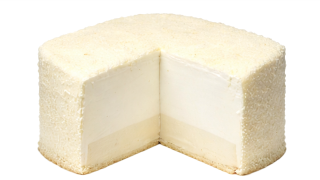
My personal favorite Holly Tries video of the year was Chaton Bakery, to try three Japanese desserts. Chaton Bakery is inside H Mart, an Asian supermarket off Parker Road in Aurora, and walking in feels both overwhelming and exciting. I could probably do a Holly Tries video on every single product in that entire store.
I found myself researching the origins of each dessert I had tried. Japanese cheesecake, for example, was influenced by German-style cheesecake when it was introduced to Japan in 1969. Cream puffs draw inspiration from French pastry traditions in the 1700s, while castella cake has roots in Portuguese sponge cake brought to Japan in the 1500s. Each dessert had a story that stretched far beyond the bakery.
This video is my favorite because it was a reminder that food is more than something we eat. It's almost like an edible history textbook, telling stories of cultural exchange, tradition, and the ways different parts of the world have influenced one another.
And I thought I was just making a video about a cream puff.
Lesson of the Year: The World Can Be Found in Aurora
After a year of trying new things, my favorite part was getting to experience a different part of the world each week.
And that brings me back to the grasshoppers.
Chapulines date back more than 3,000 years in Mesoamerica. While this experience feels foreign to me, it’s a tradition still strong in Mexican culture. So, I took a sip of my mezcal, dipped the orange in the sal de gusano, and ate my first-ever chapulín. To my surprise, it tasted a lot like barbecue. I had almost spent too much time overthinking the fact I was eating the bug that I almost missed the experience itself.
Over the past year, I've learned that trying something new doesn't mean you have to be an expert, know what to expect, or even like everything you try. To me, it meant learning how to eat a pupusa, discovering the story behind desserts, or sitting in a new restaurant and feeling like family. I've learned that you don't have to travel around the world to experience something entirely different. You just have to be willing to try what's already in your own town.